I recently finished Phase 2 of a personal project: a single-node Kubernetes cluster on AWS, built greenfield with Terraform, Packer, Ansible, and kubeadm. Most of the typing happened in Cursor, with an agent proposing diffs and me approving or rejecting them.
Several times the conversation reached a tone I now recognize as dangerous: “This should work.” “Phase 2 is essentially complete.” “You can mark this done.”
I did not mark it done. I ran the check script instead.
That gap — between the agent’s confidence and my definition of finished — is what this post is about. Not how to bootstrap a cluster. The repo holds that. This is about how I decided when the work was actually finished while building with an agent.
The agent is fast; it is not accountable
Agentic coding feels like having a very eager junior who never sleeps. It will refactor three modules because you mentioned naming consistency. It will copy patterns from a reference repo you cited once, including the parts you did not want. It will summarize progress in complete sentences that sound like a stand-up update.
None of that is malice. It is optimization for plausible continuation — keep the conversation moving, keep generating patches.
Accountability still sits with the engineer. In my day job that is obvious. On a personal project, with nobody reviewing my merge requests, it is easier to let the agent’s narrative become my narrative. We got the smoke test working can quietly become ship it even when half the gates have never run end-to-end.
I did not want that. So I borrowed a framing from Andrew Ng’s “loop engineering” newsletter and made it operational before the Terraform grew teeth.
Three loops, three different jobs
In The Batch, Issue 359, Andrew Ng describes three nested feedback loops for building products — from fast agentic iteration to slower human steering to external reality. The diagram is his; my labels below are how I applied it to a solo infra project.
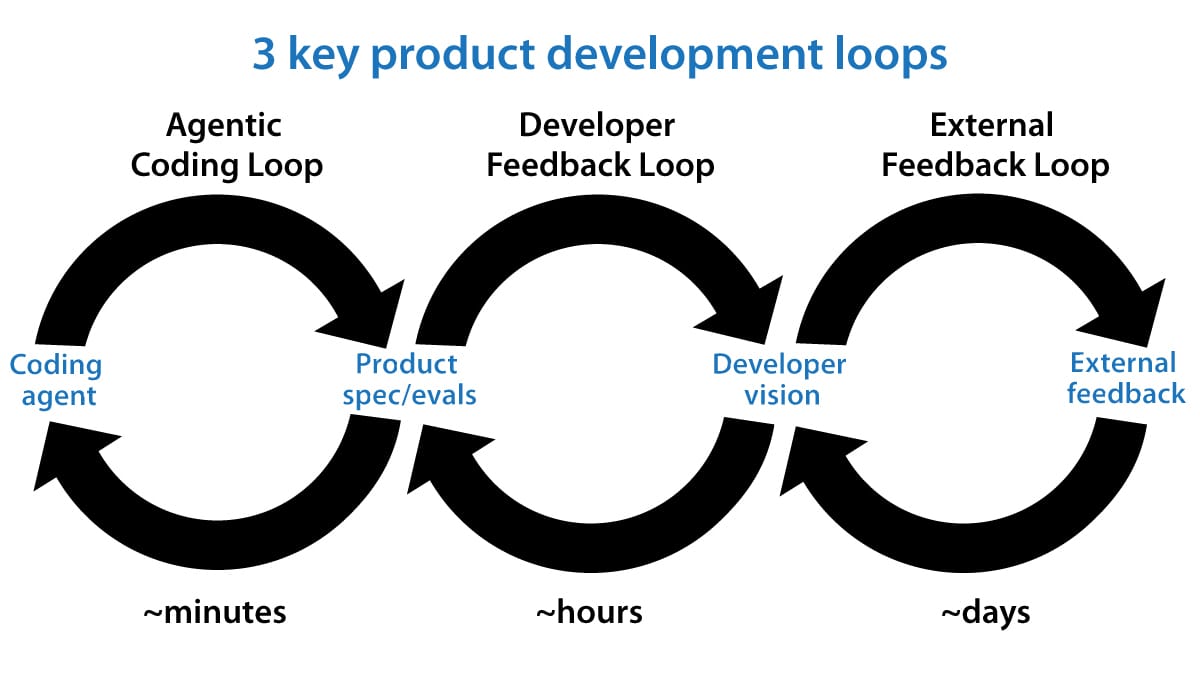
Figure: “3 key product development loops” from The Batch, Issue 359 by Andrew Ng / DeepLearning.AI. Image hosted at deeplearning.ai; click to open the source article.
Ng names them agentic coding, developer feedback, and external feedback. I mapped them onto Phase 2 like this:
Agentic coding loop (~minutes). Edit, run checks, paste failures back, repeat. The agent drives throughput; I drive direction. In Ng’s terms: coding agent ↔ product spec and evals. My evals were the gate script.
Developer feedback loop (~hours). I reject bad architecture, update written constraints, restart the agentic loop. Bootstrap belongs in the AMI first boot, not in a laptop-side Ansible playbook — even when the agent kept offering the playbook path because it looked familiar. Spec and vision live in the README reject list.
External feedback loop (~days). Metrics, users, cost surprises. Phase 2 deferred almost all of that. One private node, no vLLM yet, no ingress. The cluster factory had to work before the workload story mattered. My preview of this loop was cruder: reboot the instance from the AWS console and see if the cluster still passed checks.
The mistake I wanted to avoid was collapsing the agentic loop and the developer feedback loop. Letting the agent close the latter because the former felt green.
Objective checks before module sprawl
Early in Phase 2 I wrote a validation ladder: numbered gates, skip flags, presets for daily use versus full greenfield runs. I wrote it before the infrastructure layout hardened — on purpose.
The rule was simple. The agent does not declare Phase 2 done. A script exiting zero does.
That sounds rigid. It is. It is also the only way I found to keep agent sessions from forking into alternate realities. In one session the EICE tunnel works; in another the Packer variables were never wired across process boundaries; in a third kubelet was enabled in the script but nobody had rebooted the node. Each session had its own partial truth.
Gates turned partial truth into a single boolean.
I am not claiming this replaces code review or good design docs. For a solo builder using an agent, it replaced the missing second pair of eyes with something worse than a human but better than vibes: repeatable falsification.
What the developer feedback loop actually looked like
The developer feedback loop was not abstract. It was me saying no in writing and making the agent restart.
No bastion — EC2 Instance Connect Endpoint, because that is what I trusted from an earlier homelab. No fork of that homelab repo — greenfield paths, inspirational only. No vLLM baked into the AMI. No merging Terraform state between the Packer builder network and the cluster network. No nullable variables “for flexibility.” A long reject list, frozen in the README, so the agentic loop had guardrails.
When the agent violated a constraint, I did not argue in chat. I pointed at the constraint and re-ran the ladder. Chat is where confidence inflates. The ladder is where lies die.
The moment it felt real
The full ladder going green was satisfying. It was also insufficient emotionally.
What moved Phase 2 from probably works to I trust this was smaller: I rebooted the EC2 instance from the AWS console — not from a script I had tuned — and ran the daily preset again. Node Ready. Smoke pod up. Kubelet still enabled for boot.
That was an external-feedback preview on a toy scale. Not users, but physics. Power cycle does not care about our conversation history.
Until then I had been optimizing for the agent’s definition of progress: the next gate, the next fix, the next green run. The reboot was my developer-feedback verdict on top of the agentic loop’s automation. Finished is not merged. Finished is survives contact with reality you did not script.
What I believe now
If you build infrastructure with an agent in 2026, treat the agent as an accelerator, not an arbiter. Write down what “done” means before you write the modules. Make “done” a command anyone — including future you, tired on a Sunday — can run without interpreting chat logs.
Pre-commit hooks and formatters are hygiene. They are not the contract. The contract is the integration ladder: plan, apply, bake, bootstrap, schedule, smoke — whatever your phase actually requires, end to end.
I will keep blogging the opinions and the surprises. The step-by-step belongs in the repo and in whatever LLM you pair with next. Phase 2 is marked complete there because the script said so — after a reboot, not because the agent congratulated me.
Phase 3 is WireGuard and laptop-side kubectl. I already know the agent will have opinions. I already know which script will decide when that phase is done.